
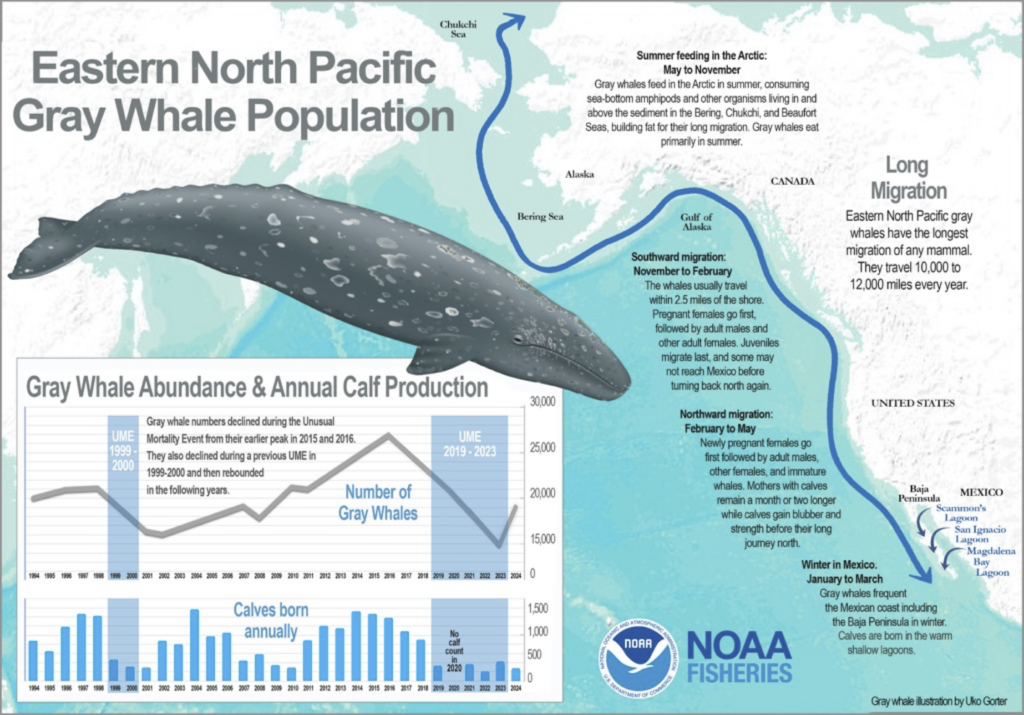
Once considered a conservation success, the eastern North Pacific gray whale population has fallen in the past decade. It peaked at an estimated 27,000 whales in 2016, but fell to roughly 13,000 by 2025, the lowest estimate since the 1970s.
By Brianna Bowman/KLCC
Scientists from Mexico, the United States, Canada, Russia and elsewhere gathered in person and virtually last week at Hatfield Marine Science Center in Newport for a landmark symposium on the uncertain future of gray whales.
Once considered a conservation success, the eastern North Pacific population rebounded after commercial whaling ended, and was removed from the U.S. Endangered Species List in 1994. It peaked at an estimated 27,000 whales in 2016, but fell to roughly 13,000 by 2025, the lowest estimate since the 1970s.
The decline coincided with a surge in strandings that NOAA Fisheries designated an Unusual Mortality Event from 2019 to 2023. This year’s estimate increased to 17,750 whales, but scientists cautioned that gray whales are not yet out of the woods. Some that stranded this year appear to be suffering from malnutrition, with changes in the Bering Sea continuing as a leading explanation.
An environment dependent on sea ice
Jacqueline Grebmeier is a professor at the Chesapeake Biological Laboratory at the University of Maryland Center for Environmental Science. She studies the ecology of the Bering Sea floor and the animals that live in and on its muddy sediment.
Among those animals are amphipods, small crustaceans that are a favorite food of gray whales. The whales reach them through a technique known as suction feeding.
“They’re the only whale that feeds off the bottom of the ocean,” Grebmeier explained. “It has to be shallow enough for them to dive. Traditionally, they go down, they scoop a bit of mud, they use their tongue to push it up against the roof of their mouth, squirt out the mud as they go up to the surface to get air, and then all the crustaceans, all the amphipods, stay, and then it goes down in their gut.”
The Bering Sea has long been recognized as an extraordinarily productive ecosystem. Its shallow depths, powerful winter storms and seasonal sea ice all help support its abundance of life.
Algae grow in and beneath the sea ice, then fall through the water and deliver an early pulse of carbon to the seafloor. A second pulse follows as the ice retreats and returning sunlight fuels large spring blooms of phytoplankton.
Following the food north
But as the ocean warms, sea ice is retreating. It no longer extends as far south as it once did, pushing that early carbon supplied by ice algae farther north. As a result, parts of the Bering Sea floor have fewer amphipods than gray whales traditionally rely on.
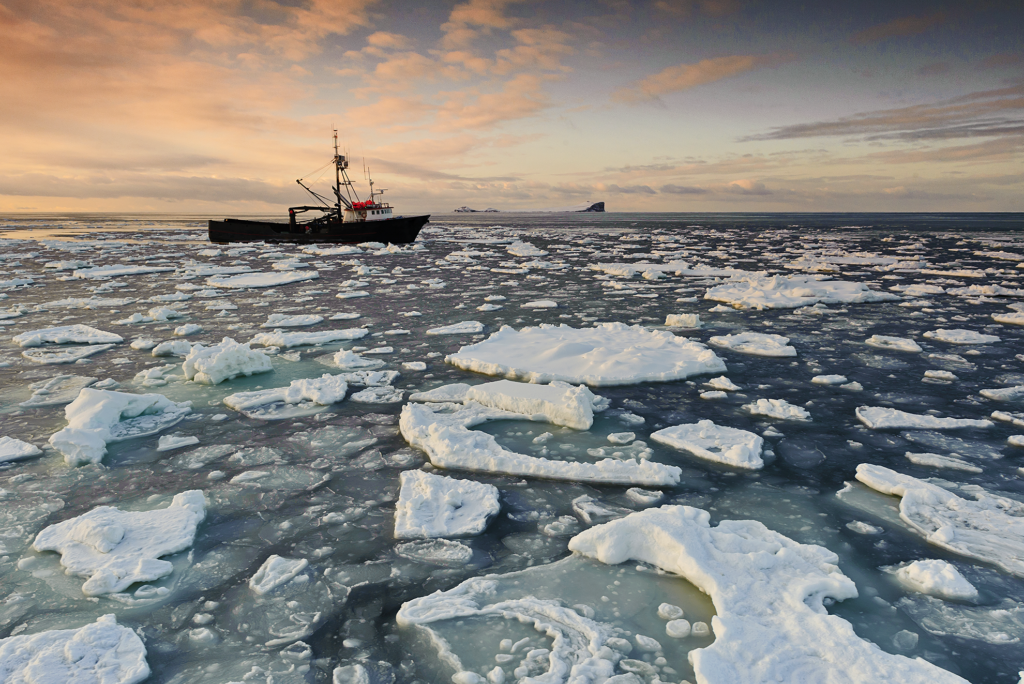
“I remember seeing them when they were just like cows in a pasture when I was a graduate student in the ’80s,” Grebmeier said. “And now we barely see them when we’re up in July. They’re actually farther up in the Chukchi Sea because the ice has pulled back.”
Scientists at the symposium repeatedly pointed to gray whales’ adaptability as a reason for hope despite their current challenges. Their ability to switch among different kinds of prey may help explain the species’ remarkable resilience.
But adaptability may not be enough. Alternative prey do not necessarily provide the same energetic payoff as amphipods. Krill, also known as euphausiids, can be comparably nutritious, but there may not be enough to sustain the same number of gray whales. Gray whales may also have to compete for krill with baleen whales better equipped to filter the tiny crustaceans, including bowhead and humpback whales, which have longer, finer baleen than gray whales.
A harbinger of broader ecosystem changes
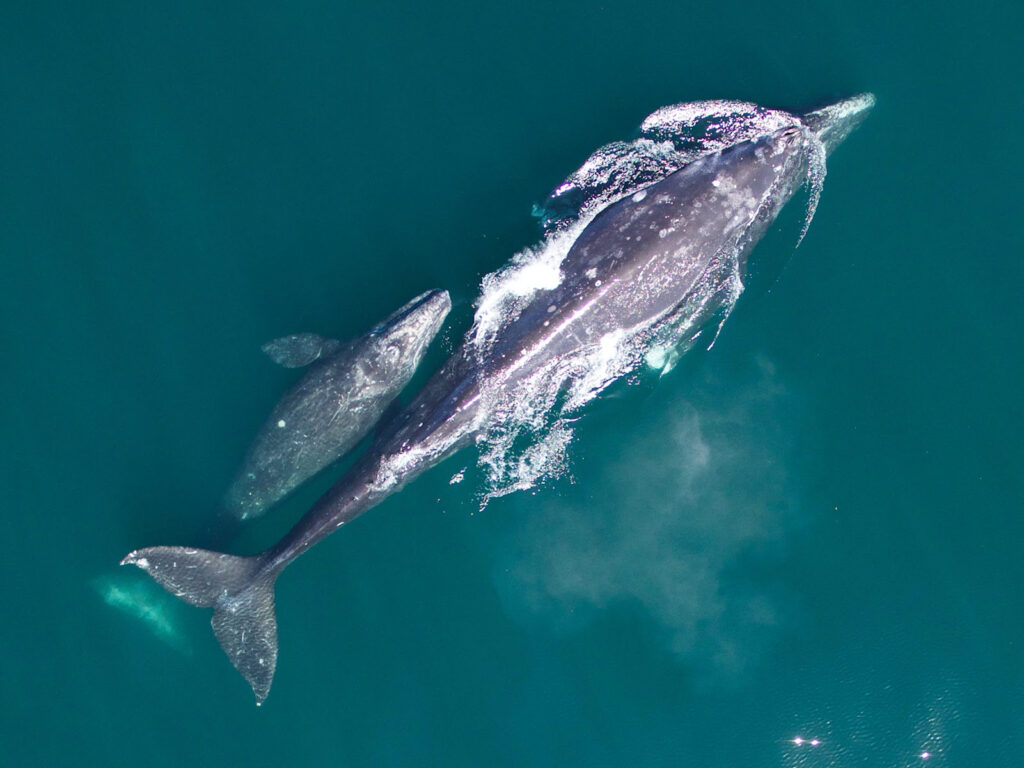
Gray whales undertake one of the longest annual migrations of any mammal, traveling between breeding lagoons in Baja California and northern feeding grounds in the Bering and Chukchi seas. The round trip can span roughly 10,000 to 14,000 miles.
Scientists still debate why such an enormous migration evolved, but one explanation is that intensive summer feeding in the Bering Sea historically provided an energetic payoff large enough to justify the journey. Today, changes in the Bering Sea are altering the availability of that food, potentially diminishing the payoff.
Gray whales will likely continue visiting favored feeding grounds along their migration route, including the waters off Depoe Bay, and finding new feeding grounds, such as in recent observations in San Francisco Bay. Scientists at the symposium considered whether such stops could become more important sources of food if the Bering Sea is no longer reliable.
According to NOAA’s 2025 Arctic Report Card, annual Arctic temperatures are rising at more than twice the global rate of temperature changes. Ultimately, the whales’ decline highlights growing concern about the rapid pace of environmental change in the far north. These changes may seem distant, but gray whales offer a warning about what is happening, and what may lie ahead.
“It is a canary in a coal mine. It’s an indicator of the health, the status and trend of an ecosystem,” Grebmeier said. “If this change is going on with the gray whales, then in fact it says something about a big change that’s going on in one of the most productive places in the world.”
This story was first published by KLCC and is used with permission