
Linnman will appear at the 56th-anniversary screening in Florence of a documentary about the dynamite-fueled removal of the dead whale that resulted in a rain of blubber.
Exploding Whale anniversary events
By Lori Tobias/Oregon ArtsWatch
In November 1970, when Paul Linnman’s editor at KATU News told him to head to Florence for a story on a dead whale, the then-23-year-old Linnman told him he didn’t do that kind of fluff. Then, his editor mentioned TNT. Within hours, Linnman was reporting on the story. It would soon make him something of an Oregon celebrity. And for a long time, he wasn’t all that happy about it.
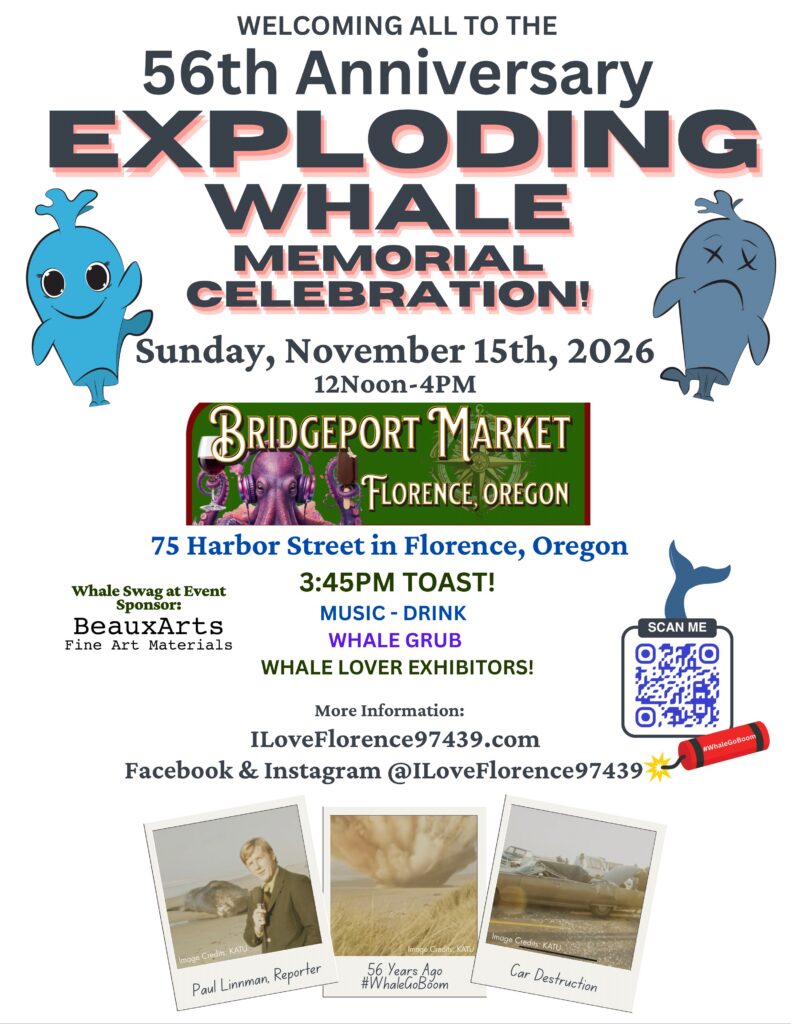
On Nov. 14-15, Linnman and the town of Florence will mark the 56th anniversary of the story most everyone in Oregon — and well beyond — knows by just two words: “exploding whale.” Linnman will make a guest appearance at the screening at City Lights Cinemas of the award-winning short-film documentary Oh Whale, and meet with fans, sign autographs, and answer questions.
It’s no stretch to say that without Linnman and his colleague, photographer Doug Brazil, the story of the exploding whale might exist only in the memory of the state workers who organized it and a few spectators. Linnman and Brazil were the only television reporters on scene and, with the exception of one Florence newspaper reporter, the only journalists, period.
Linnman recalls the day, Nov. 12, when he learned of the whale. “Doug Brazil and I were the youngest people on staff, and we liked to do things fast. We liked to get breaking stories, serious stuff,” he said. When the assignment editor said he wanted the Portland-based pair to go to Florence, the two resisted. “I said, ‘What’s the deal?’ And he said, ‘They’re going to blow it up with dynamite.’ I said, ‘OK, I’m going.’”
In case you don’t know the story, here’s a little background: Because the Oregon Department of Transportation (then the Oregon State Highway Division) is responsible for the care of Oregon beaches — thanks to Gov. Oswald West declaring the beaches public highways in 1913 — the agency was in charge of getting rid of the 45-foot, 8-ton whale that was dead on a Florence beach. As Linnman reported on that infamous day, the whale stank; the state didn’t want to bury it, because it would likely resurface; and there was no one to cut it up.
“ODOT consulted with the Navy,” Linnman told me when we talked last week. “And the Navy said, ‘If you really want to get rid of the thing, you need to dynamite it and blast it into such small pieces that the seagulls and carrion will take away the rest.’”
The state had on hand a half-ton of dynamite to do the job. As would later be reported, Walter Umenhofer, a munitions expert in his military days, warned ODOT engineer George Thornton it wouldn’t go well. “Umenhofer told him, ‘You’re doing this all wrong, buddy; you’re going to blow whale all over everybody,’” Linnman recalled. To which Thornton reportedly replied, “‘Yeah, yeah, whatever, sir. Please go away.’”
On site, state officials moved Linnman and Brazil, along with about 75 spectators, a quarter of a mile away. From their spot on the dunes, they heard the detonation and watched the explosion.
“And then you hear the stuff hitting the ground and that’s when we got frightened and started to run because that stuff is so dense,” Linnman said. “That’s when the piece came down and struck the car [which belonged to Umenhofer], flattened the roof, and now we didn’t know which way to go, because we’re trying to run away, and that thing gets flattened ahead of us, not behind us. I mean, a piece the size of your little finger could go through the top of your head.”
Somehow, no one was injured and Linnman and Brazil hurried back to the KATU studio to get their story on air. But as they were about to learn, the story had really just begun.
They shared the video with the ABC network, then, “the requests immediately began from fire companies, police outfits, hazmat crews from all over the country.” The agencies claimed to want it for training purposes, an example of the need “to be prepared for anything….”
Linnman said he and Brazil soon made a rule for responding to the constant requests. “If they gave us those BS excuses like ‘We need to share it with our hazmat team,’ we wouldn’t send it. But if they said, ‘We’d love to see it,’ we’d send it.”
British Broadcasting Company Research would report it was “the fifth most watched video in history, and the single most watched news video ever,” Linnman said. But what was it about an exploding whale that so captivated people and for so long?
That was the question that sparked Winslow Crane-Murdoch’s interest in creating the documentary Oh Whale.
“I don’t know that there’s one answer to that question,” said director Crane-Murdoch. “From my perspective, there’s two things. One, the decision to do the explosion in the first place is so ridiculous and sort of unbelievable and novel that people just can’t get enough of it.” It’s both horrible, but at the same time, because no one was hurt and the whale was already dead, hilarious, he noted. “It’s almost like a horror movie but also like a horror comedy…”
But Crane-Murdoch believes the story would have never endured as it has if not for “the genius” of Linnman’s writing, particularly the iconic line in his broadcast, “For the blast blasted blubber beyond all believable bounds.”
“There are hilarious moments throughout that whole thing,” Crane-Murdoch said. “The whole three minutes is just brilliant, and it’s a testament to local news. They shot 10 minutes. They covered exactly what they needed. It’s a piece of media that’s lasted 56 years. There is a real amount of skill that maybe gets overlooked because it’s so tongue in cheek, but that I think it is brilliant.”
The documentary premiered in October 2025 and has been on a year-long festival run. A link to the documentary was posted Thursday on The New Yorker website, and is available to the public, though Crane-Murdoch notes it’ll be a better show on the big screen in Florence. He and co-producers Cecilia Brown and director Luke Terrell are planning an “Oscar campaign” for the film.
While the world was getting their kicks watching the exploding whale, Linnman moved on. He was reporting other more important stories, winning awards, and producing and reporting the feature series, Spirit of the Northwest, about “ordinary people doing extraordinary things.” Still, people only recognized him as the reporter who covered the exploding whale.
“I was really kind of nonplussed by it,” Linnman said. “I thought, get on with your life. A few years ago, a guy passed me going into Albertsons, didn’t even slow down, and said, ‘Hey blubber boy, how’re you doing.’ I’ve done thousands of stories…. I covered the 1968 presidential primary in Oregon; I followed Robert Kennedy and Eugene McCarthy. I was with George Wallace a week before he was killed…. I’ve won Emmys for my reporting. Some of them are my all-time favorite stories, and I’m never asked about any of them. I used to get really bugged.”
Then one day a colleague pointed out, “People produce stories their entire career that they’re never asked about. You’re asked about this constantly. Why don’t you just accept it and kind of enjoy it?’ And I thought, maybe he’s right, and so I got over it.”
These days, he likes sharing some of the stories that grew from the whale. One came when a colleague called and said Linnman needed to call the BBC. So, he called. The person answering the phone said they were live on the air at that very moment. “She was just delighted,” Linnman recalled. “And then I hear this British woman’s voice on the air, ‘And joining us now from across the pond, live, the man himself, Paul Linnman.’”
As it turned out, that day a dead whale loaded on a flatbed truck in Taiwan unexpectedly exploded. Linnman said the British TV anchor told him, “‘You have to forgive me. We’ve been laughing about this [the exploding whale in Florence] on this side of the pond for years. Now, can you, as an exploding whale expert, tell us how that whale in Taiwan blew up today?’ I said, ‘I’m not an expert and no, I can’t tell you how that whale blew up.’”
Last year, Linnman and his wife, Vicki, went to the Portland premiere of Oh Whale. “The line went around the block to get in, and when I walked in with Vicki, people were saying, ‘That’s him! There’s the guy. That’s Paul.’ In television, all those years, you get recognized, but never that kind of reaction, like they were seeing a rock star or something.”
This story was first published by Oregon ArtsWatch and is used with permission