
ELECTION 2026
A School Bond FAQ
Answers to some common questions regarding the Siuslaw School District bond measure
Written and photographed by Will Yurman
- Completed ballots must be postmarked on or before May 19th, or dropped off in an official drop box no later than 8 p.m. on May 19.
- Florence’s drop box is in front of the police station at 900 Greenwood St in Florence.
- Election Ballots were mailed to eligible voters beginning April 30th.
- If the bond is approved, the money can be used only for the construction project. Funds cannot be used to pay for day-to-day operations at the school. And they cannot be used to support or fund the charter school.
May 19 election ballots have been mailed to voters and the $139 million bond measure is on the ballot for residents in the Siuslaw School District.
A yes vote is a vote in support of the 30-year bond to build a new high school and renovate part of the elementary school.
A no vote means the district will need to consider other options or offer the same bond measure in November’s general election.
Good questions have been asked online and in the comments to earlier stories on this site about the specifics – why does it cost what it costs, how were these numbers calculated, what if it goes over budget (spoiler – it can’t), and what’s next if the measure passes or fails.
Below is an email exchange,lightly edited for clarity, with high school principal Mike Harklerode and Laurel Ferguson, a member of the Citizens for School and Community:
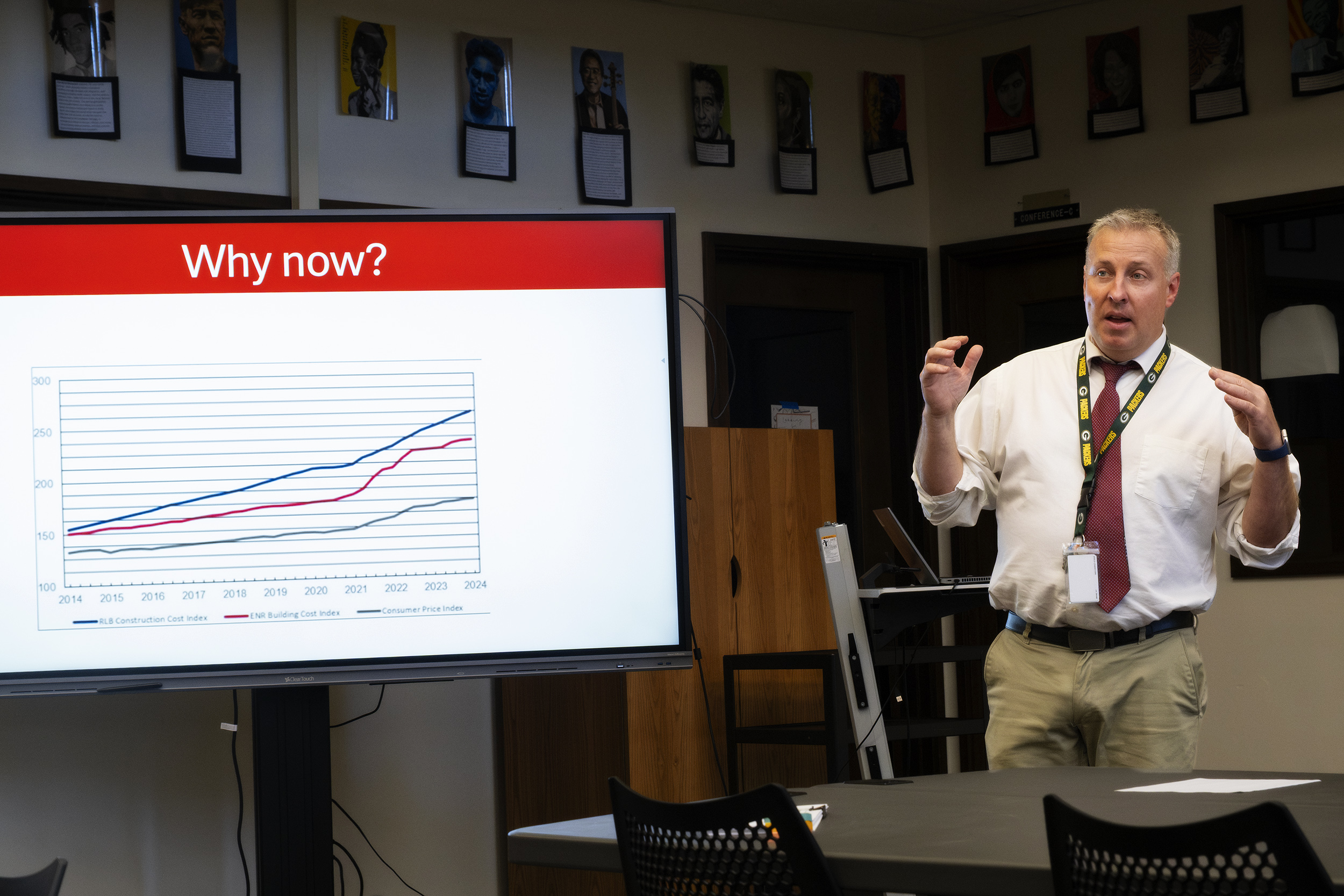
Q. Many people are questioning where the $126 million figure for the high school comes from — why so high, what do we get for that amount? What is the specific process the facilities committee used to compute the $126 million cost of the high school? Is there a standard method for calculating the costs, given you don’t yet have firm design plans?
A. From the start, the committee worked with Curt Wilson as a consulting architect. Curt has experience with determining square footage needs for particular building elements. Finding local and regional comparisons is part of the process.
For our purposes, the recently completed North Eugene High School(NEHS) was the best comparison. The needs were different, but we were able to use the unit cost as a starting point.
The square footage costs for NEHS are calculated at $578 per square foot in Q1 2029 costs.
The square footage costs for our new school are calculated at $513 per square foot Q1 2029 costs.
While the student populations between the two schools are far apart, all schools have a need for common elements like halls, cafeterias, common areas, athletic spaces and gyms. These are relatively static from project to project. The big difference between the two schools will be in the number of classrooms.
Note, too, that the total maximum cost for the new high school with an auditorium is closer to $116 million. The other $10 million, to get to $126 million, includes the cost of demolition of the current high school, the new high school parking lot, fire lanes and traffic flow changes, and updates to the athletic fields. All the estimated expenses are built in, with anticipated increases for inflation and rising construction costs, as well as contingency planning.
Q. Can you offer a more specific breakdown of how the money would be spent?
Budget Highlights
$513/square foot for the high school (1st quarter 2029 costs)
$106,766,400 High School
$9,890,359 Auditorium
$10,095,581 Various costs, including demolition, parking lot, fire lane, bus loop, athletic field, and field house.
-$6,126,000 OSCIM grant
$5,939,020 Elementary School renovation
$2, 994,022 Four classroom addition to the Elementary school
$5,368,148 Additional work on the Elementary School
-$2,500,000 SRGP grant
Q. There have been many questions about how the cost compares to other school projects in Oregon. One comment on West of the Tunnel says the project is costing twice as much per student as other projects. Is that a fair representation, and if so, why is it so high?
A. Part of this is answered in question 1. Some school elements are needed for all sizes/locations. Those drive up the per-student calculation for smaller schools.
It’s very difficult to compare any one project to another, because there are fundamental differences in all school construction projects. For example, building at the coast means we have different requirements as noted below.
Q. Can you compare this project to specific other projects? Creswell comes up often in comments online, but some have mentioned N. Eugene, and projects closer to Portland. Specifically, one online commenter wrote: The data suggest the construction costs are HIGHER in Beaverton than in Florence (due to higher wages, proximity to Portland and the huge demand in the Portland metro area.) Despite this, Beaverton is spending a bit more than 1/2 per Student on its high school than Siuslaw proposes.
A. While I can’t speak to the vagaries of the labor market, we do know we have to pay prevailing wage, as in all school projects. We have the additional challenge of having to hire out-of-town contractors and having building materials shipped from I-5 to the coast.
We also have two particular engineering challenges. The first is seismic codes that are more stringent on the coast and on sand. The second is the need to be engineered for higher wind sheer concerns than schools based in the valley.
Comparisons to Creswell may seem logical but they don’t consider the needs or conditions of the school itself. Creswell is largely a wood structure. The tilt-up concrete walls at SHS make it more challenging to restructure than schools of wood construction.
Q. How did you decide to assume a growing student population over the next several decades, given the declining population of school-aged kids that is predicted, at least into the short-term future?
A. We requested a study from the Lane Council of Governments (LCOG).

In addition, we expect the new school will attract more families and students. This has been the prevailing trend in other communities.
It’s important to remember that the current high school is 110,000 sq feet, and that does not include the auxiliary gym or the four modular classrooms.
Excluding the modular classrooms, the high school has 21 instructional spaces, but only 17 were originally built as classrooms. The other four have been modified from office and storage spaces. The high school also does not have an auditorium, and does not have a full-sized cafeteria.
The current building is too small, and has been for some time, even before the current large class of seniors. The new building is meant to be comfortable for the projected student population over the next five years, and also to accommodate moderate growth in the future without having to ask the community to pay for an expansion. The goal is to meet current needs while future-proofing the building to avoid additional costs to our community.
Q. Can you address concerns that construction projects often go over budget, and that would cost taxpayers even more on the bond? What happens when the assessed value of a home goes up? Would that increase the amount a property owner would pay on the bond?
A. The $139 million of this bond is the ceiling. Simply said, we will have to design and build within this budget. As part of the board resolution to authorize the bond for the ballot, we will form a Bond Advisory Committee to oversee all stages of the process. There are also built-in design checks at all major points in construction to ensure the best options and designs are used.
** According to the Lane County Assessor’s office, assessment increases are capped at 3% per year. Because the entire district would see the same increase, the individual tax burden for the bond wouldn’t change. Each property owner would pay the same percentage of what is due on the bond. As our assessed value goes up, the rate would drop because the bond amount is fixed. As opposed to general taxes, which can grow year over year.**
** If the property tax base grows over time from, for example, new construction, the amount owed would be spread out over a larger tax base, reducing everyone’s bond burden**
Q. Can you clarify other sources of income for the bond and for operating expenses? Many people online want to know why money from the lottery isn’t helping with construction or with hiring teachers, improving outcomes, etc.
A. This has been a common question. Money from the state lottery (and marijuana revenue) was originally earmarked for schools. However, those funds were met with a decrease to the state school fund allocations. In other words, this money IN allowed for other money to go OUT of the funding formula for schools. This was the work of the Oregon legislature.
Operating expenses come from the State School Fund , which is made up of property tax revenues. Nearly 90% of each district’s budget is spent on salaries and benefits. Operating funds can be used for smaller scale projects. This is how we paid for the kindergarten modulars in 2014 and the high school modulars in 2022. In both cases, the district was able to purchase the modular buildings without asking taxpayers to cover the cost.
It does not work in the other direction. We cannot use construction dollars to fund operations. They can only be used for the identified purpose of building or improving physical structures.
The state OCSIM grant — which is awarded annually to state-identified priority schools — is the only state funding available for major school capital projects. The district would also be eligible to apply for up to $2.5 million dollars in state funds for the necessary seismic improvements at the elementary school. Siuslaw was lucky enough to be awarded an OCSIM grant of $6.1 million, but only if the bond passes in the May 2026 election cycle.
Q. If the bond passes, what are the next steps, and what is the timetable until the new high school opens?
A. After the Bond Advisory Committee is formed, we would seek an RFP for school designers.
Another RFP to hire a contractor would follow.
Site preparation, drawing permits, evaluations, design work and hiring a contractor would take 12-18 months. Another 18-24 months of construction would follow before we are able to move into the new school or have the ES project finished. We have not discussed the order of the ES or the HS phases of the project.
Q. If the bond fails, what’s next?
A. The district would continue to maintain the buildings to the best of our ability, and the Board would have to assess how to proceed. The Facilities Advisory Committee was intentional in creating a durable proposal, so the likely next step would be preparing for another bond measure. However, the project will immediately become $6 million more expensive with the loss of the OCSIM grant, construction and other costs will continue to rise, and the building facilities will continue to deteriorate.
Q. What are the concrete downsides of renovating the existing building? David Twombly, in the story on West of the Tunnel, proposed spending in the $40 million range, believing that would take care of the major structural issues and allow for fixing some of the other issues at the school. Can you address specifically why you believe that isn’t cost-effective or educationally sound?
A. I cannot speak to how Mr. Twombly arrived at his figures.
Our architect’s calculations for a basic renovation, without adding any extra square footage, came to about $83 million dollars. This includes approximately $26 million in costs for seismic upgrades that would be required, and another $57 million to bring all systems and fixtures up to date and up to code. Once the project starts, we are required to bring all affected elements into compliance with current state and federal building codes, so it would be very difficult to tackle any one major issue in isolation. For example, replacing the HVAC system would mean opening up some of the walls, which then triggers seismic code compliance and probably asbestos remediation in some areas.
We also anticipate some unknown costs that can’t be projected until the project gets underway. We don’t know exactly what we’ll find once it gets started.
This cost also doesn’t reflect the need to purchase transitional classrooms for students to occupy during construction.
Additionally, the estimated time frame for a renovation would be a staged remodel over 6-8 years. Bond funds of this nature typically must be used within five years, so for a renovation of the scale required, we would be faced with multiple bond cycles. In that case, the district would have to hope that the community passes a second bond in the future in order to complete the project.
A renovation of the existing building would also have a much larger impact on disruptions to student learning. Even if some transitional classrooms were purchased, we would be looking at six or more years of students going to school in a construction zone. The remodel also does nothing to address the traffic issues or the divided campus. With a new high school, students can continue to attend the current building until the doors open in the new facilities, and at the end of the day we have a new building in a better location that allows for traffic improvements and a united district campus.
Hi Will excellent work as always, just one additional comment, according to Andy G (this was in the Siuslaw News article) the $83m estimate for repair/remodel of the high school was done at the beginning of the committee’s work 2024 and based on 2024 dollars, so compared to some of the other numbers in your article, this estimate has not been adjusted for inflation. Quick adjustment puts that figure conservatively (using 3-4%) $93-$96m in 2028 dollars.
Thanks, Scott. I contacted Principal Harklerode to confirm, and you are completely correct. The committee’s estimate for renovating the existing building was determined in 2024 and does not account for inflation.
Excellent presentation…and for those that attended and followed this project, it was just confirmation for me.
In my opinion, renovation is out of the question because it is throwing good money to a seriously failing building.
It has become apparent that the cost of education is immeasurable…